Autumn Semester 2026 Graduate Courses
Comparative Studies
This list is current as of May 4, 2026. Course schedule and descriptions are subject to change. We are adding here course-specific descriptions, as well, as they become available. Please refer to SIS for the most up-to-date information. Contact arceno.1@osu.edu if you notice any discrepancies or have any questions.
COMPSTD 5240 / PUBAFRS 5240 / AFAMAST 5240 Race and Public Policy in the United States
MW 9:35-10:55 | Miranda Martinez | Hayes 025
This course explores Race and Public Policy in the United States from Reconstruction to the present. In particular, the class is designed to look at the long list of "hot topics" in the current policy landscape, including policing, housing, wealth gap, immigration, voting, political representation, and others. Cross-listed in African American and African Studies and Public Affairs. Not open to students with credit for AFAMAST 5240 or PUBAFFAIRS 5240.
COMPSTD 6300 Foundations: Comparative Analysis and Sociocultural Theory
Wednesdays 11-1:45 | Sam Aranke | Hagerty 451
This course aims to help students become more lucid about the role that comparison plays in their thinking and doing while also introducing them to a range of social and cultural theory. Assignments are designed to prepare students for a successful conference presentation and journal publication on a topic of their choice in their own field of inquiry.
COMPSTD 6750.01 / ENGLISH 6751.01 Theorizing Folklore I: Philology of the Vernacular
Tuesdays 3:15-6 | Merrill Kaplan | Denney 447
This course serves as an introduction to the canonical folklore genres and the history of folklore as a discipline. Why and how do we examine the vernacular? This course counts towards the Folklore GIS. Cross-listed in English.
COMPSTD 7360 Theorizing Culture
Fridays 9:15-12 | Morgan Liu | Hagerty 451
This course focuses on the concept of culture as it has developed over time, with emphasis on the tension between descriptive and normative approaches.
COMPSTD 8100 Interdisciplinary Learning Lab I: Improvisation in Context and Practice
Wednesdays 2:15-5 | Melissa Curley + Liliana Gil | Hagerty 451
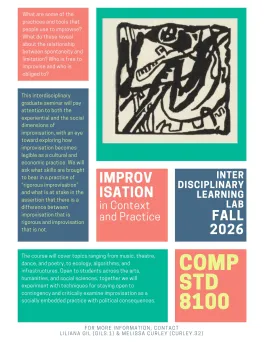
What are some of the practices and tools that people use to improvise? What do these reveal about the relationship between spontaneity and limitation? Who is free to improvise and who is obliged to?
This interdisciplinary graduate seminar will pay attention to both the experiential and the social dimensions of improvisation, with an eye toward exploring how improvisation becomes legible as a cultural and economic practice. We will ask what skills are brought to bear in a practice of "rigorous improvisation" and what is at stake in the assertion that there is a difference between improvisation that is rigorous and improvisation that is not.
The course will cover topics ranging from music, theatre, dance, and poetry, to ecology, algorithms, and infrastructures. Open to students across the arts, humanities, and social sciences, together we will experiment with techniques for staying open to contingency and critically examine improvisation as a socially embedded practice with political consequences.
Enrollment in Spring 2027's COMPSTD 8200 is encouraged but not required for students outside Comparative Studies.
COMPSTD 8791: Seminar in Interdisciplinary Theory: Phenomenology of Embodiment and the Senses
Tuesdays 12-2:45 | John Brooks | Hagerty 451
This course offers an introduction to phenomenology of embodiment. It approaches the/a/your body as a prism through which the world is experienced to theorize how perception, the senses, and sensation are constitutive of all that can be known. The role of the body in making/breaking racial knowledge will be a key theme. Our schedule will put philosophers like Maurice Merleau-Ponty, Jean-Luc Nancy, and Michel Serres in conversation with cultural theorists like Frantz Fanon, Fred Moten, and Tina Campt. We will also examine art by Senga Nengudi, Kara Walker, and Adrian Piper to underscore how embodiment animates Black performance studies. How does ocularcentrism produce racial knowledge? What are the historical roots of this visual/philosophical regime? How might the sonic contribute to its rupture? Can we imagine a philosophy founded on critical listening? What other radicality can we revive by retheorizing our bodies and the sense-giving of the senses?
COMPSTD 8890 / Dissertation Writing Workshop
Mondays 12-2 | Miranda Martinez | Hagerty 451
Since the dissertation is often your first effort to construct a complex, original, and extended argument, interpretation and/or analysis, this writing workshop will assist you in developing concrete strategies for tackling this major task, hold you accountable for making progress on the dissertation, and contribute to the creation of an intellectual community among Comp Studies graduate students. Repeatable to a maximum of 9 cr hrs or 9 completions. This course is graded S/U.